











Hindutva group stages anti-Muslim hate-filled tableau in Uttar Pradesh
text_fields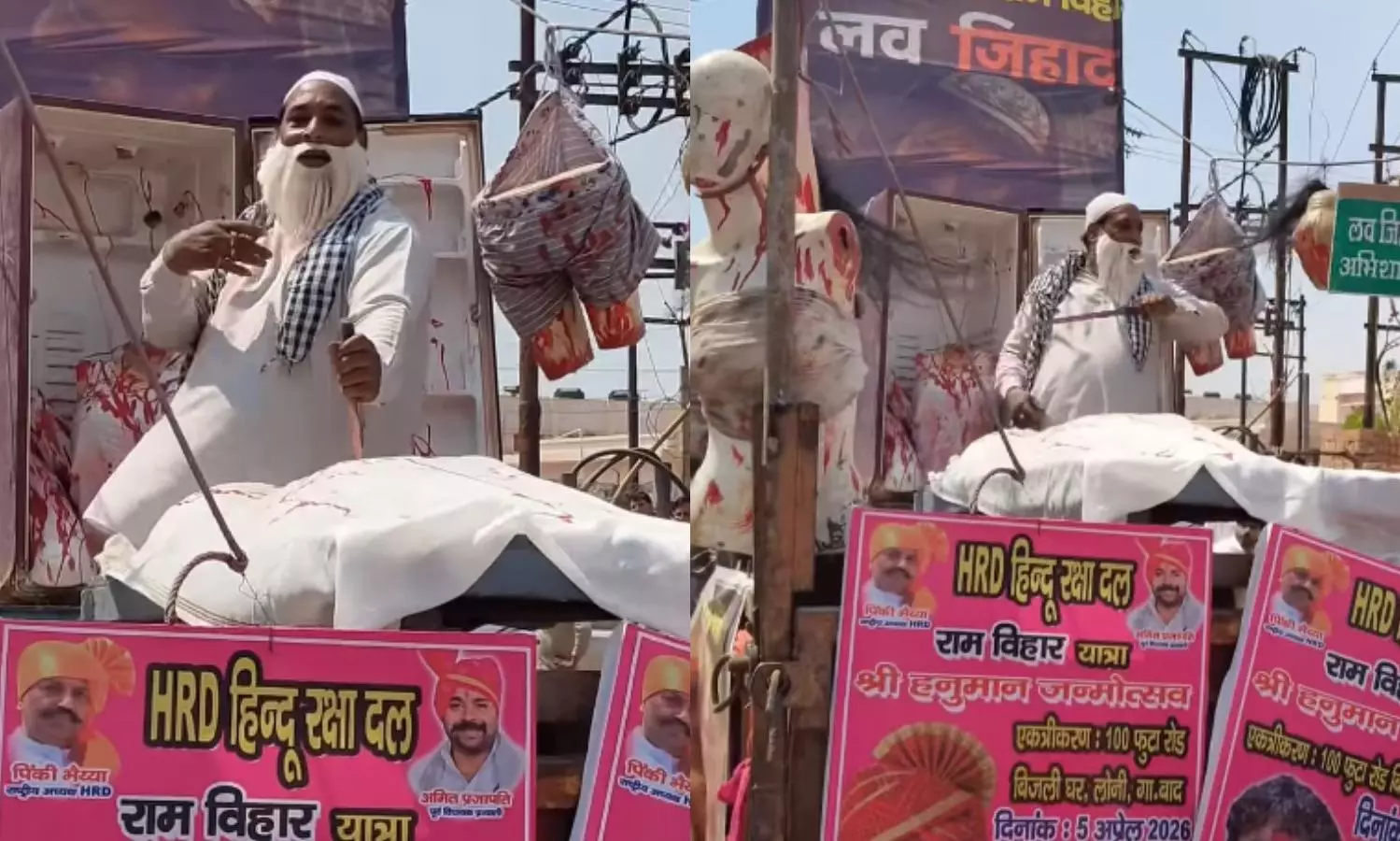

Ghaziabad: A religious procession in Uttar Pradesh’s Ghaziabad on April 5 has drawn scrutiny after it featured a violent tableau depicting the consequences of the controversial “love jihad.” During the event, a participant dressed in attire associated with a Muslim identity enacted a staged assault, repeatedly stabbing a surface while a prop representing a severed woman’s head was displayed alongside, creating a gory, graphic public spectacle, Siasat reported.
The procession was organised by the Hindu Raksha Dal after securing official permission from local authorities. Police indicated that approval had been granted with conditions attached, but the nature of the visuals has since prompted administrative concern. Officials have assigned the Assistant Commissioner of Police in the Ankur Vihar subdivision to examine the event and determine whether further action is warranted.
The organisers described the march, referred to as a “Dharmodaya Yatra,” as an effort to “raise awareness and unite society in the defence of religion.”
However, the imagery used has intensified debate over the increasing presence of provocative and violent narratives in public religious events
Similar themes were observed during Ram Navami celebrations in multiple regions, where processions incorporated staged scenes illustrating alleged interfaith relationships framed as coercive or deceptive. In Pune district, a separate tableau presented a dramatised storyline in which a Muslim man, supported by his family, was shown luring a Hindu woman, reinforcing the same narrative.
In Dhayari village, these depictions were presented in a highly visual and explicit manner as they moved through public streets, attracting attention from onlookers. The tableaux also referenced imagery associated with The Kerala Story, a film widely criticised for promoting disputed claims and contributing to polarised perceptions about interfaith relationships.
The recurrence of such portrayals across different locations has raised concerns about the spread of inflammatory messaging through religious gatherings, particularly when accompanied by graphic representations of violence.