







Kerala polls 2026: LDF, UDF, and NDA offer competing visions on welfare, jobs, and infrastructure
text_fields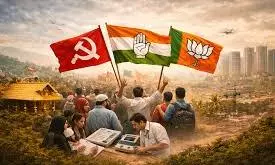

Ahead of voting in the 140-member Assembly on April 9, the three main contenders in Kerala have released manifestos laying out sharply different approaches to welfare, healthcare, employment, infrastructure, and financial management.
The contest is primarily between the ruling Left Democratic Front and the opposition United Democratic Front.
The state has 2.71 crore registered voters, including 1.31 crore men, 1.38 crore women, and 277 transgender persons.
Polling will take place across 25,231 stations.
Counting is scheduled for May 4, and the term of the present Assembly ends on May 23.
The Left Democratic Front has built its campaign around continuity after ten years in power. Its manifesto says the government will identify around five lakh of the poorest families in the state and support them out of poverty. It has promised to raise the social security pension to Rs 3,000 a month.
In healthcare, the LDF has promised universal access through a system of unlimited treatment under a universal health coverage model. It has also proposed a preventive care programme called a lifestyle disease-free Kerala and plans to create a unified digital health record system for all residents.
On jobs and education, the LDF says students completing their education in the state will receive campus placement opportunities. It has also proposed a “Connect to Work” scholarship and a mentorship network for young people entering the workforce.
The front has promised a Rs 2 lakh crore investment push and says it will expand public sector enterprises with a target turnover of Rs 10,000 crore by 2031. It has pledged to ensure 50 per cent employment for women and create 20 lakh jobs for homemakers.
The LDF manifesto also reiterates support for a north-south high-speed rail corridor and metro rail projects in Thiruvananthapuram and Kozhikode. It says the Water Metro system will be expanded, and major railway and highway projects will be completed.
On financial management, the LDF has defended its current approach and said it will resist what it calls financial restrictions imposed by the Union government through legal and administrative measures. It has also said that state revenue will be increased through taxes while continuing its model of welfare spending and capital investment.
The United Democratic Front has presented itself as an alternative to the LDF while retaining some similar welfare measures. Under what it calls “Indira Guarantees”, the UDF has promised to raise all welfare pensions to Rs 3,000 a month and make them a statutory right.
The UDF has also promised a daily minimum wage of Rs 700 for ASHA workers, Rs 1,000 a month for college-going girls, and free bus travel for women.
In healthcare, the UDF has proposed the Oommen Chandy Health Insurance Scheme, which would provide coverage of up to Rs 25 lakh for each household. It has also promised that hospital beds will be treated as a right and proposed “no-bill” hospitals based on the JIPMER model. The manifesto includes doorstep delivery of medicines for elderly people.
The UDF has linked healthcare and nutrition through a promise to open subsidised “Indira Canteens”.
On poverty reduction, the UDF has said it will relaunch and update the Asraya scheme. It has also proposed a special programme for families holding yellow and pink ration cards.
In education and employment, the UDF has proposed setting up a “Job Watch Tower” to monitor global job trends and align higher education with future employment opportunities. It has also promised a law named after Rohith Vemula to address caste discrimination in educational institutions.
For farmers, the UDF has promised a minimum support price of Rs 300 per kg for rubber. It has also proposed creating a rubber company modelled on Cochin International Airport Limited and said it will implement the recommendations of the Swaminathan Commission on minimum support prices.
The UDF manifesto also proposes “Mission Samudra” to integrate the state’s 600-km coastline and improve maritime connectivity. It has promised to scrap the SilverLine project and denotify land already acquired for it.
The front has also outlined measures to address human-wildlife conflict. It says the Forest Department will be made responsible for preventing wild animal intrusions, while a separate tribunal will be created to provide compensation. The UDF has also proposed legal changes to deal with the issue.
On governance and finance, the UDF has proposed using artificial intelligence to improve GST collection and audit systems. It has also promised to create a Non-Resident Keralite Investment Fund.
The National Democratic Alliance has offered a different model focused on greater private participation and closer alignment with Union government schemes.
Like the other fronts, the NDA has promised a welfare pension of Rs 3,000 a month, but only for people above 70 years of age, widows, and poor women who head households. It has also proposed “Bhakshya Arogya Suraksha” cards that women can use to buy groceries and medicines.
In healthcare, the NDA has promised to expand coverage under Ayushman Bharat. It has also proposed setting up an AIIMS in Kerala and developing Kozhikode into a medical hub.
For women and households, the NDA has promised two free LPG cylinders every year during Onam and Christmas. It has also pledged housing for landless families and 20,000 litres of free water each month.
On employment, the NDA has proposed a Rs 1 lakh soft loan for every job created. It has also promised new industrial estates and a state-level Production Linked Incentive scheme to attract private investment.
In agriculture, the NDA has promised a support price of Rs 250 per kg for rubber, along with a 5 per cent increase every year. It has also proposed a “Tropical Fruit Mission” to encourage farmers to move away from dependence on rubber and adopt multi-cropping.
The NDA manifesto includes a promise to build a high-speed rail network from Thiruvananthapuram to Kannur and improve air connectivity in the state.
The alliance has also taken a separate position on the Sabarimala gold theft issue. It has promised a time-bound CBI inquiry and changes in temple administration.
On human-wildlife conflict, the NDA has proposed preventive measures, including better forest resources and early warning systems.
For financial management, the NDA has promised asset monetisation, improved tax collection through technology, rationalisation of government expenditure, and restructuring of public sector units to make them more efficient.