




America grows more inclusive, India more exclusive
text_fields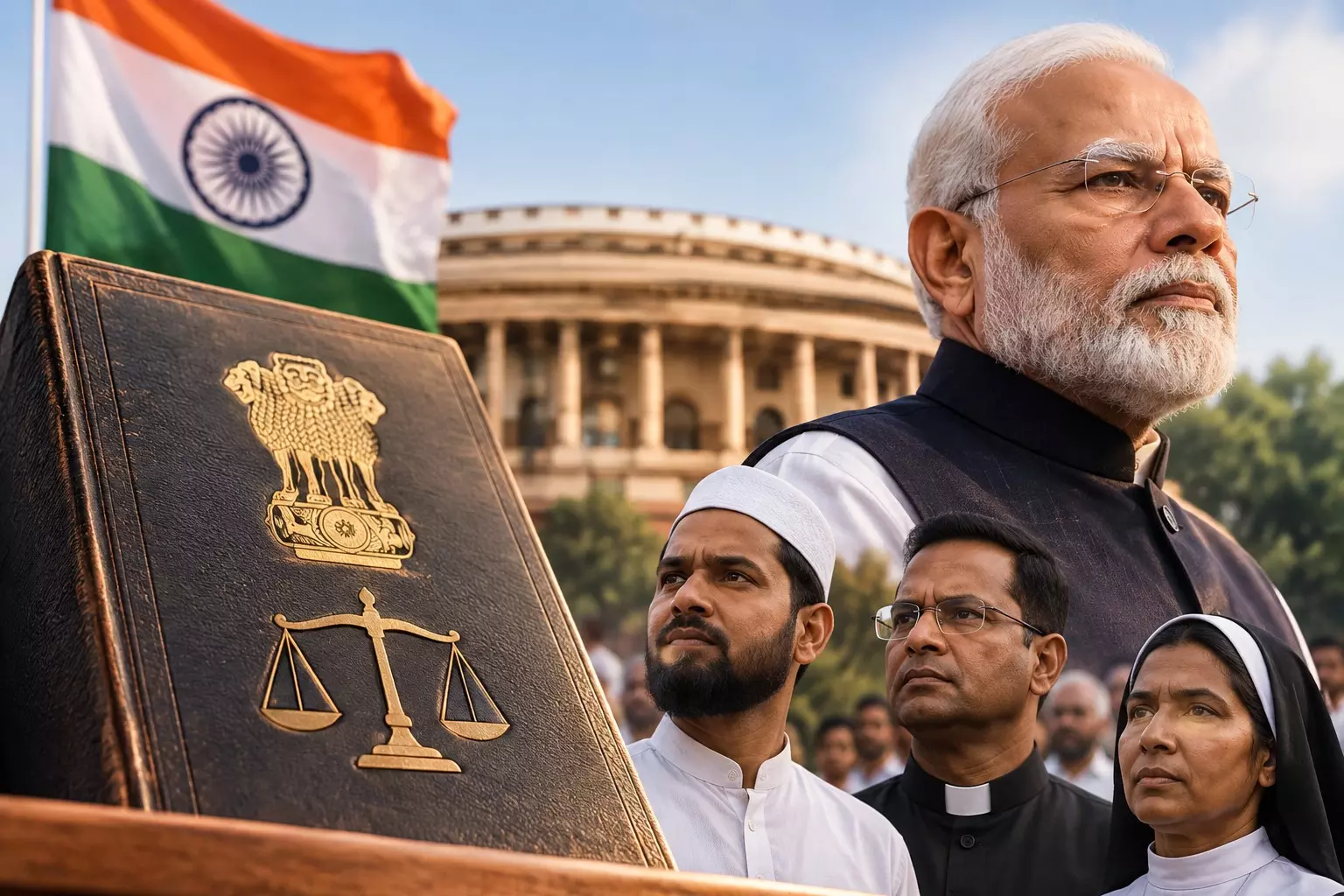
Sometime in November 2008, a well-known Indian editor told me that Barack Obama had no chance of becoming President of the United States. His argument was simple. Americans might talk about equality, but deep down they were racists.
They would never elect a black man to occupy the White House. There was another reason, too. Obama’s father, Barack Hussein Obama Sr., was a Kenyan who had been raised as a Muslim.
History proved him spectacularly wrong. Obama never concealed his parentage. On the contrary, he wrote Dreams from My Father, which became a New York Times bestseller. Another important book was The Audacity of Hope. His father’s religious background did not prevent Obama from winning the confidence of American voters.
A year after assuming office, Obama was awarded the Nobel Peace Prize. In 2012, he secured a second term, defeating Republican Mitt Romney. Both times, I remembered the Indian editor’s confident prediction. His assessment had been based more on his own prejudices than on an understanding of the American electorate.
What has prompted me to recall this conversation is another remarkable development in American politics. Abdul El-Sayed, a Democrat from Michigan, has been elected to the United States Senate, becoming the first Muslim elected to that institution. He will take office on January 3, 2027, succeeding retiring Senator Gary Peters.
El-Sayed is a physician with an MD from Columbia University and an epidemiologist who earned a DPhil from Oxford University as a Rhodes Scholar.
His victory is particularly significant because he won despite attempts to make his religious identity an election issue. Voters chose to judge him by his ideas and his ability to represent them rather than by his faith. That is how democracy should function.
There is an additional reason why his election is heartwarming for Indians. His wife, Dr Sarah Jukaku, is of Indian origin. She was born and brought up in Michigan and is a practising psychiatrist. Her family traces its roots to Bhatkal, a coastal town in Karnataka’s Uttara Kannada district.
Her father, Dr Tayeb Jukaku, graduated from Bangalore Medical College in 1976 and migrated to the United States in the 1980s. Her grandfather, J.H. Shamsuddin Jukaku, was a prominent lawyer, educationist and politician. He served as a legislator and Deputy Minister for Finance and Electricity in the former Mysore State government headed by B.D. Jatti, who later became India’s fifth Vice-President.
Sarah and Abdul met while studying at the University of Michigan. They married in May 2006 and have two daughters, Emmalee and Serene.
El-Sayed is not an isolated example of America’s changing political landscape. Nithya Raman, a politician of Indian origin, has been elected Mayor of Los Angeles, the country’s second-largest city. New York, its largest city, is headed by Zohran Mamdani, a Muslim whose mother is the Indian filmmaker Mira Nair. He is the city’s first Muslim mayor and the first of South Asian origin.
Mayors in major American cities wield considerable executive powers. Unlike in India, where the office is often largely ceremonial and much administrative authority rests with municipal commissioners, American mayors exercise real control over city administration and public services.
The November elections also brought success to several other people of Indian origin. Among them was Juli Mathew, a Malayali, who was re-elected as a judge in Fort Bend County in the Houston area of Texas for the third consecutive term. Her achievement is another reminder that Indians in America are increasingly occupying positions of political and judicial responsibility.
These developments reflect the salad-bowl character of the United States. The country was built by immigrants from different parts of the world. They brought with them different languages, religions, cultures and traditions. They did not necessarily abandon their identities to become Americans. Instead, they became part of a larger national identity. Their children and grandchildren are now finding their place in the country’s political institutions.
Now let us turn our gaze towards India. The contrast is disturbing.
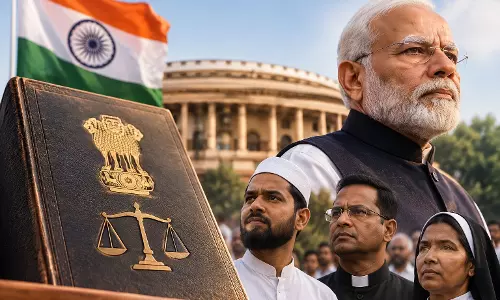
India takes pride in being the world’s largest democracy and has a Constitution that guarantees equality to all citizens irrespective of religion. Yet, there is not a single Muslim or Christian minister in the Union Council of Ministers headed by Narendra Modi. Their representation among Governors is also negligible. In BJP-ruled states, members of these communities are rarely accommodated in ministerial positions.
India once had leaders who understood that national politics should rise above religious identities. Maulana Abul Kalam Azad, one of the tallest leaders of the freedom movement and independent India’s first Education Minister, reportedly resisted the suggestion that he should contest from a Muslim-majority constituency.
He wanted to demonstrate that he could win from a Hindu-majority constituency. His idea of India was not based on religious compartments. He believed that a Muslim could represent Hindus and a Hindu could represent Muslims. Unfortunately, that spirit appears to be diminishing.
Muslims constitute 14.2 per cent of India’s population, according to the 2011 Census, the latest completed national census. Yet their representation in Parliament and state legislatures is far below their share of the population.
The decline in their representation in State Assemblies is particularly worrying. According to recent figures, the number of Muslim MLAs across the country has fallen from around 339 in 2013 to approximately 255 in 2026. In Uttar Pradesh, their number has declined from 63 to 31. In West Bengal, it has fallen from 59 to 37, while Bihar has seen a decline from 19 to 11. Rajasthan, too, has witnessed a reduction from 11 to six.
These are not insignificant statistical variations. They point to the growing political marginalisation of a community that constitutes nearly one-seventh of India’s population. The decline has coincided with the rise of the BJP and the growing influence of majoritarian politics over the past 12 years.
Political parties are free to select their candidates, and voters have the right to elect or reject them. But when such a large section of the population finds itself increasingly absent from legislatures and governments, the country must ask whether its democratic institutions adequately reflect its diversity.
America has certainly not overcome all its racial and religious prejudices. Discrimination continues, and its political climate is often deeply polarised. Yet, the election of Obama, Mamdani, Raman and now El-Sayed demonstrates that its electorate is capable of looking beyond a candidate’s colour, religion and ancestry.
The irony is difficult to miss. America, with its history of slavery and racial segregation, is opening its political doors to people of different ethnic and religious backgrounds. India, which fought a long freedom struggle and enshrined equality and secularism in its Constitution, appears to be moving in the opposite direction.
While we congratulate Abdul El-Sayed on his historic victory, it should not prevent us from looking at the uncomfortable reality at home.
Democracy is not merely about counting votes and forming governments. It is also about ensuring that every section of society feels represented in the institutions that govern it. A country cannot claim to be truly inclusive if a substantial section of its population remains politically marginalised.