















When education becomes a competitive marketplace
text_fields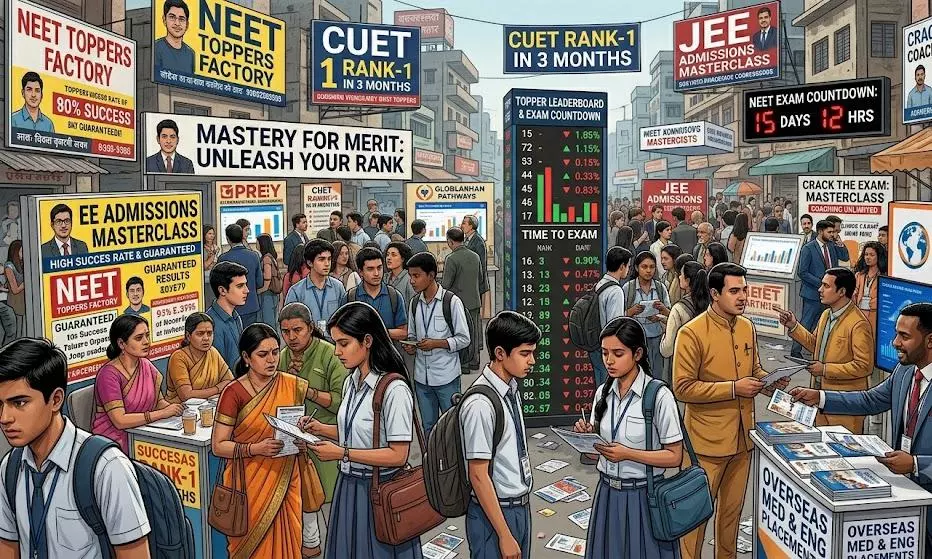
A popular quote says: “Destroying any nation does not require the use of atomic bombs or long-range missiles. It only requires lowering the quality of education and allowing cheating in examinations.”
There is no certainty about who first said it. Some attribute it to Nelson Mandela. Whether he said it or not is less important than the truth it contains. Recent developments in India suggest that our education system is being weakened from within, not by enemies across the border but by policies and practices that are creating confusion, inequality and frustration among students.
Five years ago, some teachers associated with the Sangh Parivar objected to students from Kerala, especially girls from Malappuram, securing admission to prestigious colleges of Delhi University. Their argument was that some state boards awarded marks more liberally than others. As a result, students from such states were allegedly cornering seats in courses such as Economics Honours at colleges like Hindu College.
To address such complaints, the University Grants Commission introduced the Common University Entrance Test (CUET) for admissions to Central universities from the academic year 2022-23 onwards. From then on, marks obtained in Plus Two examinations became largely irrelevant. A student scoring 100 per cent in school examinations would not get admission if the CUET score was poor.
The idea appeared attractive. A common test would create a level playing field. But reality has proved very different.
CUET is conducted by the National Testing Agency. It is a multiple-choice examination in which students simply select one answer from four options. It tests speed, technique and familiarity with objective-type questions more than depth of knowledge or wisdom. Students who can afford specialised coaching have a clear advantage.
In cities like Delhi, many schools informally allow students to spend considerable time in coaching centres while pursuing their Plus Two studies. Students from poorer families or rural areas cannot compete on equal terms. As a result, the examination system increasingly rewards coaching rather than learning.
One unintended consequence has been the decline of institutions that once promoted social mobility. Jawaharlal Nehru University had an admission system that gave weightage to students from disadvantaged backgrounds and remote regions. This enabled many lower-middle-class and poor students to enter higher education. CUET has largely ended that approach.
The anxiety created by the examination process is enormous. School board results have already been announced across the country. Yet CUET results are expected only in July. Students and parents remain in suspense for weeks.
There is no guarantee of success because the examination includes negative marking. To make matters worse, many students are allotted distant examination centres. This year, several Delhi students initially received centres in cities such as Jaipur, Dehradun and Agra. Only after protests were alternative arrangements made.
One of my relatives had to appear for examinations on three different days. Each time, the centre was located on Delhi’s outskirts. Parents had to spend money and time transporting their children. For poorer families, such expenses are significant.
Meanwhile, private universities are flourishing. Universities such as Ashoka, Jindal, Lovely Professional University, Shiv Nadar, Sharda and Galgotias have completed admissions. Students who can afford their fees do not wait for CUET results. Some universities charge fees approaching one lakh rupees a month. Wealthier families send their children abroad to the United States, Britain, Australia or Canada.
The uncertainty surrounding CUET has become a blessing for private universities and coaching centres. It has certainly not helped poor students. Even appearing for the examination costs money. My relative paid Rs 1,500 merely to sit for the test.
The story is similar in medical education. Earlier, admission to medical colleges depended largely on Plus Two marks. Institutions such as Christian Medical College, Vellore, also conducted interviews to assess a candidate’s aptitude and commitment to serving patients.
Then came the National Eligibility-cum-Entrance Test (NEET). Today, clearing NEET without coaching is extremely difficult. Students spend months memorising thousands of objective questions. The coaching industry has become an essential partner in the examination process.
The consequences are tragic. Question paper leaks have repeatedly shaken confidence in the system. This year, controversies forced the authorities to order a re-examination. Students who had spent months preparing saw their plans collapse overnight. Some were pushed into severe emotional distress. A young student from Kanjangad in Kerala took her own life after disruptions to her examination plans. Sadly, she was not alone.
Now another concern has emerged. The Central Board of Secondary Education has moved towards a highly computerised evaluation system. Human examiners are increasingly replaced by digital processes.
This year, Class XII student Sarthak Sidhant drew attention to alleged irregularities in the On-Screen Marking system. His study of procurement documents suggested repeated alterations in tender conditions that appeared to favour a particular private company. Whether all his conclusions are accepted or not, the episode raises important questions about transparency and accountability.
Higher educational institutions are not free from criticism either. A friend’s daughter secured a high rank for postgraduate admission and hopes to study at IIT Delhi. However, she was compelled to accept admission at IIT Ahmedabad because Delhi had not yet completed its admission process. If she eventually gets a seat in Delhi, she will lose a substantial portion of the fees already paid. Such situations are unfair to students.
There was a time when talent was encouraged differently. The National Talent Search Examination identified promising students and supported them financially for years. Scholarships helped deserving students pursue higher studies regardless of family income. Thousands benefited from the scheme. Then there was a scholarship programme to benefit minority students.
These programmes have disappeared. In its place, public attention is often directed towards events such as Pariksha Pe Charcha, where selected students are brought to Delhi at government cost to interact with Prime Minister Narendra Modi and receive copies of his book Exam Warriors. Such events may be useful as motivational exercises, but they cannot substitute for a sound educational policy or a fair examination system.
The central issue remains unresolved. Education is becoming increasingly dependent on coaching centres, computerised testing and expensive entrance examinations. Students are under unprecedented pressure. Parents are anxious. Poor families are disadvantaged. Private educational businesses are thriving.
India’s examination system is being damaged from within. Every year brings new controversies, delays, paper leaks, technical failures and admission uncertainties. Yet there appears to be little accountability. Union Education Minister Dharmendra Pradhan continues to preside over one examination muddle after another without facing serious consequences.
What a contrast this is with the early years of independent India, when Maulana Abul Kalam Azad guided the Education Ministry with vision, scholarship and a deep commitment to nation-building. Education was then seen as a public good. Today, it increasingly resembles a competitive marketplace.