












Satellite images reveal scale of Iran's worsening water crisis
text_fields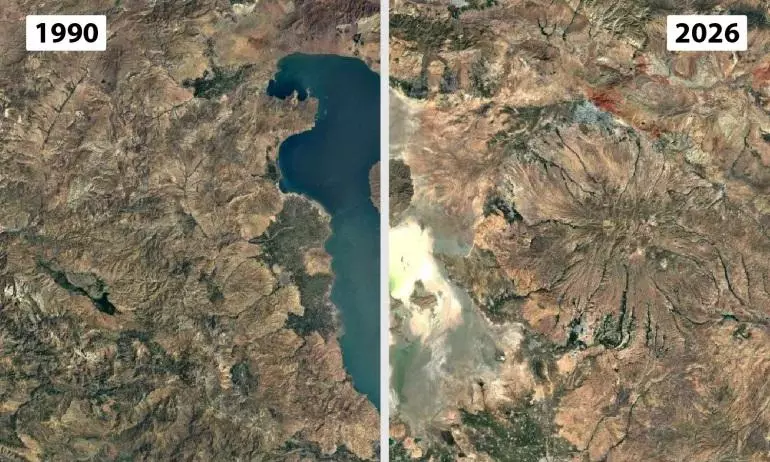

Tehran: Iran is facing a deepening water crisis driven by years of drought, declining rainfall and unsustainable water consumption, with recent conflict-related damage to water infrastructure adding further pressure to already strained resources.
For many Iranians, water scarcity has emerged as one of the country's most pressing challenges. Reports indicate that the recent US-Israel conflict caused damage to desalination plants, pipelines and other civilian water infrastructure, exacerbating existing shortages.
According to the World Resources Institute, Iran faces "extremely high" baseline water stress, using more than 80 per cent of its renewable water resources annually.
One of the most visible signs of the crisis is the dramatic decline of Lake Urmia in northwestern Iran. Once the largest saltwater lake in the Middle East, the lake covered nearly 6,000 square kilometres in the 1990s. It has since shrunk to about 581 square kilometres, less than 10 per cent of its former size.
Experts attribute the lake's decline to consecutive droughts, intensive agricultural water use, river diversions and extensive groundwater extraction. More than 60 dams constructed on rivers feeding the lake have reduced inflows, while rising temperatures and reduced precipitation have accelerated evaporation.
Iran's growing water deficit has further compounded the problem. In 2025, the country's population of about 92 million consumed nearly 100 billion cubic metres of water, around 13 billion cubic metres more than the volume of renewable resources available.
Agriculture remains the dominant consumer, accounting for approximately 91 per cent of total water withdrawals. Household use represents about seven per cent, while industry consumes roughly two per cent. Ageing and inefficient irrigation systems also contribute significantly to water losses.
The impact is also evident in reservoirs supplying the capital. Water levels in dams including Lar, Latyan and Mamloo, which form a crucial part of Tehran's water supply network, have fallen sharply in recent years due to prolonged drought and increasing demand.
Water scarcity is increasingly driving migration from rural areas. According to Iranian Vice President for Rural Development and Disadvantaged Regions Abdolkarim Hosseinzadeh, only 38,000 of Iran's 69,000 villages remain inhabited, while 31,000 have been abandoned.
The country's state-owned Water and Wastewater Company reports that about 27,000 villages, home to more than 10 million people, are currently experiencing water shortages. More than 70 per cent of Iran's villages are facing some form of water-related crisis.
Many residents have moved to major urban centres such as Tehran, Mashhad, Isfahan and Shiraz in search of more stable livelihoods. However, these cities are also struggling with growing pressure on water supplies. Tehran, with a population exceeding nine million, has witnessed increasing strain on its water system as demand rises and drought conditions persist.
The effects are also visible along the Zayandehrud River, one of central Iran's most important waterways. Satellite imagery shows declining water levels at Zayandehrud Dam, while sections of the river passing through Isfahan have repeatedly run dry. The historic Allahverdi Khan Bridge, also known as Si-o-Se Pol, now often spans dry riverbeds rather than flowing water.
Desalination contributes only a small share of Iran's water supply, accounting for about three per cent of national demand. Most desalination facilities are located along the country's southern Gulf coast, limiting their ability to support inland cities and agricultural regions that remain heavily dependent on conventional water sources.