







US Secretary of State Marco Rubio states China has not provided military aid to Iran during Gulf crisis
text_fields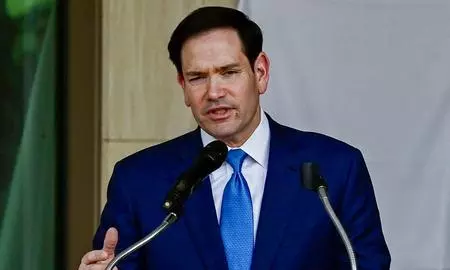

Washington: US Secretary of State Marco Rubio has confirmed that the United States has detected no evidence of China providing military assistance to Iran during the ongoing regional crisis. Testifying before a House Appropriations Subcommittee hearing, Rubio responded to questions from lawmakers regarding Beijing's relationship with Tehran and whether it had offered support during recent hostilities, stating that China had not provided any assistance to Iran that impeded American operations or the ability to operate.
While acknowledging that Iran possesses military equipment of Chinese origin and maintains long-standing diplomatic ties with Beijing, Rubio clarified that Washington has not observed any recent Chinese actions that altered the battlefield dynamic during the conflict. He described China’s approach to the situation as cautious, suggesting that Beijing has actively sought to avoid becoming directly entangled in the crisis despite its broader strategic partnership with the Iranian government.
At the same time, the Secretary of State called on China to play a more constructive role at the United Nations, particularly regarding international efforts to secure and restore freedom of navigation through the Strait of Hormuz. Rubio noted that Washington is currently backing a UN Security Council resolution designed to address disruptions in the strategic waterway, which handles a substantial portion of global oil shipments, arguing that if Beijing is truly against the closure of the straits, it should endorse the resolution or at least abstain rather than use its veto.
Rubio argued that China faces significant economic incentives to support efforts aimed at restoring regional stability due to its heavy reliance on global trade and energy flows. He warned that as time goes on, the Chinese economy will begin to be negatively impacted by Iranian actions, noting that prolonged disruptions in maritime routes could severely hurt both energy supplies and export markets for an export-driven economy like China. To underscore the rising risks posed by the instability in regional shipping lanes, Rubio also revealed that a vessel bound for China had recently been struck during the crisis.
These developments carry significant weight for Asian markets, particularly for major energy importers like India and China that rely heavily on oil transported through the Gulf. Any prolonged disruption or escalation in the Strait of Hormuz threatens to trigger a sharp rise in crude oil prices, drive up international shipping costs, and disrupt supply chains across the entire region.
(Inputs from IANS)