
















Freedom - of the country and of the people
text_fields

After a month from India's 80th anniversary of independence, the debate over how much freedom the citizenry of the country has enjoyed has not ended for its people. Many have shared their concerns about the denial of civil liberties, including the right to life, freedom of thought, freedom of expression, human rights, and freedom of movement. That remaining so, most of the remarks in a recent article by former Supreme Court judge Justice Deepak Gupta were about the shortcomings of the judicial system in safeguarding people's freedom. It is true that there are scores of examples of the judiciary acting as guardians of civil liberties. However, the judiciary's role taken as a whole, there is room for disappointments too. The crucial check is whether judges do, and are able to perform their duties fearlessly and impartially. For the last few years, there has been a pattern of judges going by the government's stand in court cases. When the government takes action against the dissenting opinions and protests of the citizens, it is the judiciary that should stop them. However, in such cases, the citizens are helpless and are forced to approach the higher courts themselves. The high courts, and often even the Supreme Court, fail to provide redress to such grievances. Arrest and incarceration constitute denial of the right to life. Umar Khalid and Sharjeel Imam are examples of people who have to spend a long time in prison without getting bail. The two, who were arrested in connection with the riots in northeast Delhi during the protests against the Citizenship Amendment Act, have been in prison for six years. The Supreme Court, at the insistence of the prosecution, has denied bail to both of them on the charge of 'larger conspiracy' for the riots. At the same time, a bench of the same court had questioned the validity of this long imprisonment. This is a situation where the physical and financial hardships required for court proceedings themselves become a punishment.

Three facts are particularly noteworthy in this regard. First, 75 percent of those in prisons in India are in pre-trial detention, meaning that only 25 percent are convicted prisoners. This is natural when the situation is that if someone expresses a dissenting opinion, protests, or becomes suspicious of the police, they are promptly rounded up and locked. And the executive leaves the rest to a later date. Second is the tendency to delay trials for years without even starting them. Over a dozen senior intellectuals and human rights activists who participated in the Elgar Parishad protests in Maharashtra were held in prison without trial only to be released on bail one by one after a long time. One of them, Stan Swamy, died in jail after spending more than four years in jail. Despite the lapse of eight years since the incident, the trial has not yet begun. Why is there no effort to try and convict them quickly? The answer lies in the statistics provided by the government itself in Parliament. Only 2.5 to 2.8 percent of those imprisoned in UAPA cases were convicted between 2014-2022. And of those who have been tried, only 21 to 25.7 percent were convicted. Those awaiting trial forms 94 percent.
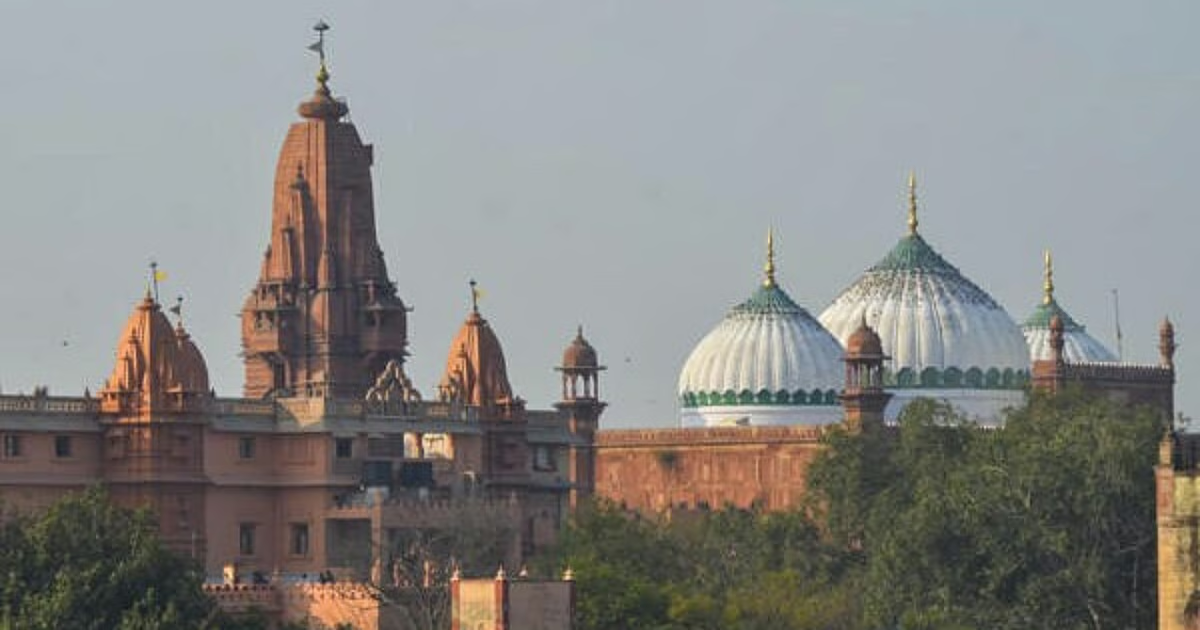
Thirdly, of late the courts themselves have been nullifying in effect the verdicts passed by the Parliament. In many cases, we see judgments that take the side of majoritarian sentiments. The Places of Worship Act, passed in 1991, had ordained that the status quo of any place of worship in the country as on 15th of August 1947, except the Babri Masjid, should not be changed. In the 2019 Supreme Court verdict on Ram Temple construction, the courts had also expressly prohibited the courts from considering claims over any other place of worship. However, come 2023, the Supreme Court itself allowed the Archaeological Survey of India to conduct a 'survey' in the Gyanvapi Masjid case to verify whether there was a temple where the mosque stood. The court rejected all the objections that it would be a violation of the 1991 Act, on the grounds that it was only a survey. With this, there arose a situation where the courts will consider claims over many other mosques as well. Many mosques have become disputed sites and some have even become temples, thereby bypassing a law passed by the Parliament. And most recently, places of worship of the minorities went into such an unsafe state that the Saharanpur mosque in UP got demolished by the government itself. If the people lose faith in the judiciary, one of the three pillars of the democratic edifice, then the very existence of the system will come under question. In India, a multi-religious, multi-caste and multi-ethnic nation, although the British will no longer come and snatch the country's freedom, if the freedoms promised to the people are lost one by one, it will be a threat to the health of the nation itself, a scenario that should be taken seriously.